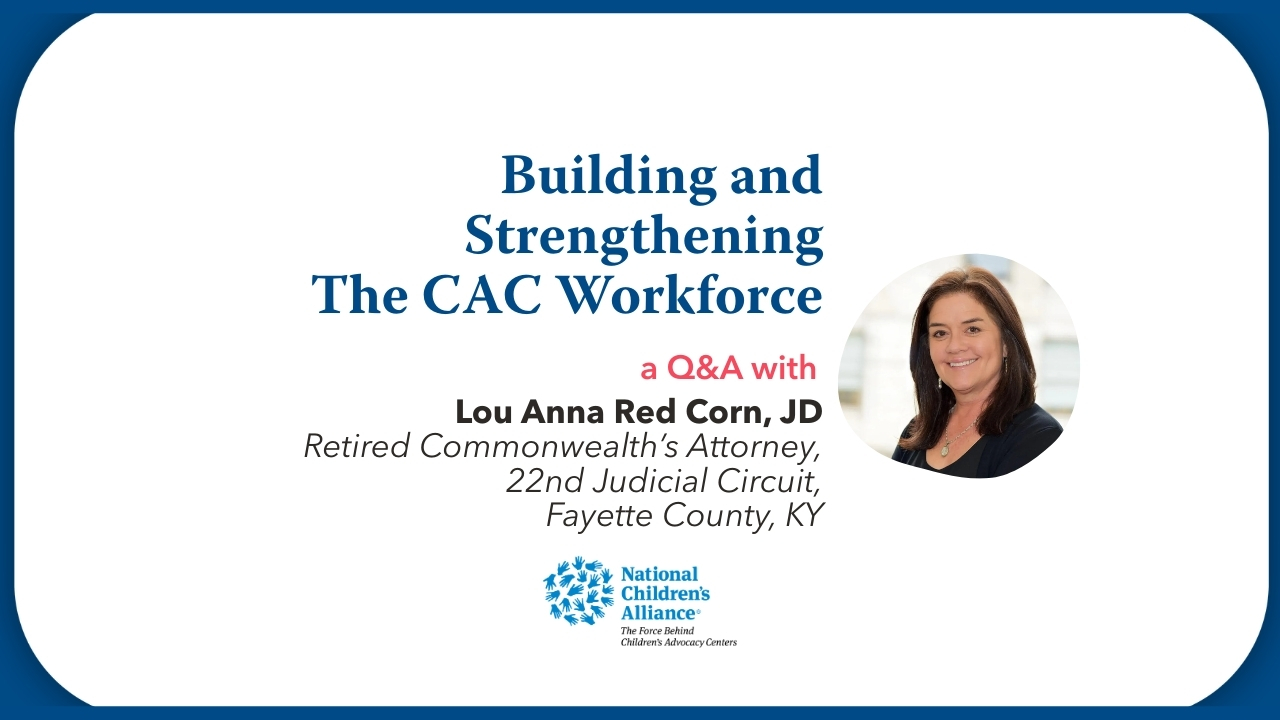
Building and Strengthening the CAC Workforce | a Q&A with Lou Anna Red Corn
March 10, 2026
Building and Strengthening the CAC Workforce, an interview with Lou Anna Red Corn, co-chair of the Workforce Development Project Steering Committee.
CACs know well that a world-class workforce is what’s needed to meet the needs of the kids who come through their doors. Yet the challenges CACs face to grow and develop the CAC workforce, retain quality staff, and develop CAC professionals into movement leaders are major barriers. Enter the Workforce Development Project, created by CACs, for CACs. The Project kicked off in February 2024 with over 60 volunteers from Regionals, Chapters, CACs and other stakeholders as a part of Vision 28: NCA’s Strategic Plan.
 We sat down with Lou Anna Red Corn, a retired Kentucky prosecutor, CAC movement leader, and former NCA Board Chair, to ask her about her role in the Workforce Development Project. She was the co-chair of the Steering Committee with NCA Vice President of Programs, Kim Day. During her time as a prosecutor, she tried over 232 felony jury trials, including 56 homicide trials. Much of her work focused on the protection of children through prosecution. She is a founding and current board member of the Children’s Advocacy Center of the Bluegrass in Lexington, Kentucky.
This is her perspective on the project she helped lead.
Q: Tell me about the Workforce Development project.
A: As a board member and as a person that’s been involved in the field since 1987, the goal was to create the kind of workforce for children and families that are dealing with sexual abuse should have when they walk into a Children’s Advocacy Center.
There were three areas that were identified: leadership opportunities for people working in CACs and then increasing the number of mental health and medical providers in the field. As one of the steering chairs, I had the opportunity to see how each of the groups went about identifying the problems and then coming to solutions.
There are not enough resources to address everything, so the problems were prioritized and voted on, bearing in mind cost and the ability to implement the solution broadly. The work groups then brainstormed solutions to the problems they identified. In the end, it resulted in the Workforce Development Project Report and Recommendations.
Q: Why were you personally involved in this project as a volunteer?
A: Having spent 35+ years as a prosecutor and having done a lot of work with child sexual abuse victims in court, and then with my own Children’s Advocacy Center, I felt like I had some useful information that I could offer. But more than anything, it was a project that was worthy of time because the outcome and the potential for good in the future is so great.
Q: What are the overarching themes of problems that we are trying to solve with this workforce development project?
A: To me, the overarching theme is ensuring that the services that children receive when they walk into a Children’s Advocacy Center are best practices from a top-notch workforce. That’s just what children and families deserve. We need a process to make sure that people that get into the field, like the work or love the work, view it as a mission, stay in the field, feel supported, and that there is opportunity for advancement for them.
Providing the best services is incumbent on keeping the best people. Unfortunately, some of these areas of mental health or medicine don’t get the same attention or resources. It’s extremely emotionally demanding for these practitioners. If we want to have the best people in place to do this really, really important work, how do we do it? What can we do to draw people into the field and keep them in the field? And it’s training, resources, and income. It’s also their own mental health in doing the work.
Q: If you succeed, where do you see the CAC workforce in 20 years?
A: I would hope that it would be the kind of position that people that are graduating from college or graduate programs in mental health or medicine would want to be a part of. They should get personal satisfaction from helping these children and be paid properly for their work. The work should be manageable for them so they can stay, not for their whole career necessarily, but certainly for periods of time where they could do the work and children could benefit from them.
Q: What does a just future for kids 20 years from now look like?
A: I think all of us would say the first thing is that a just future for any child is a world where there is no abuse, right?
Understanding that that future is probably unlikely, then a just future is one where every child has the opportunity to grow up healthy. It’s one of these little phrases that we use where you don’t just survive; you thrive. But that’s just true. When it comes to children that have been sexually abused, it’s not enough to survive the incident. What is required of us as adults and communities that provide care to these children is to give them all of the services, skills, and whatever is needed for them to have a healthy life as if they had never been abused in the first place.
Q: And are there any other questions I should have asked you and didn’t, or any other information you want readers to know?
A: I’m so thankful for the time that professionals in the field gave to this project. Having the ability to see what each of these work groups did month after month was not just incredible, but I was really filled with awe that people would give their time like that. And so, these end products are as solid and thorough and based in best practices as you could hope for.
__________________________________________________________
