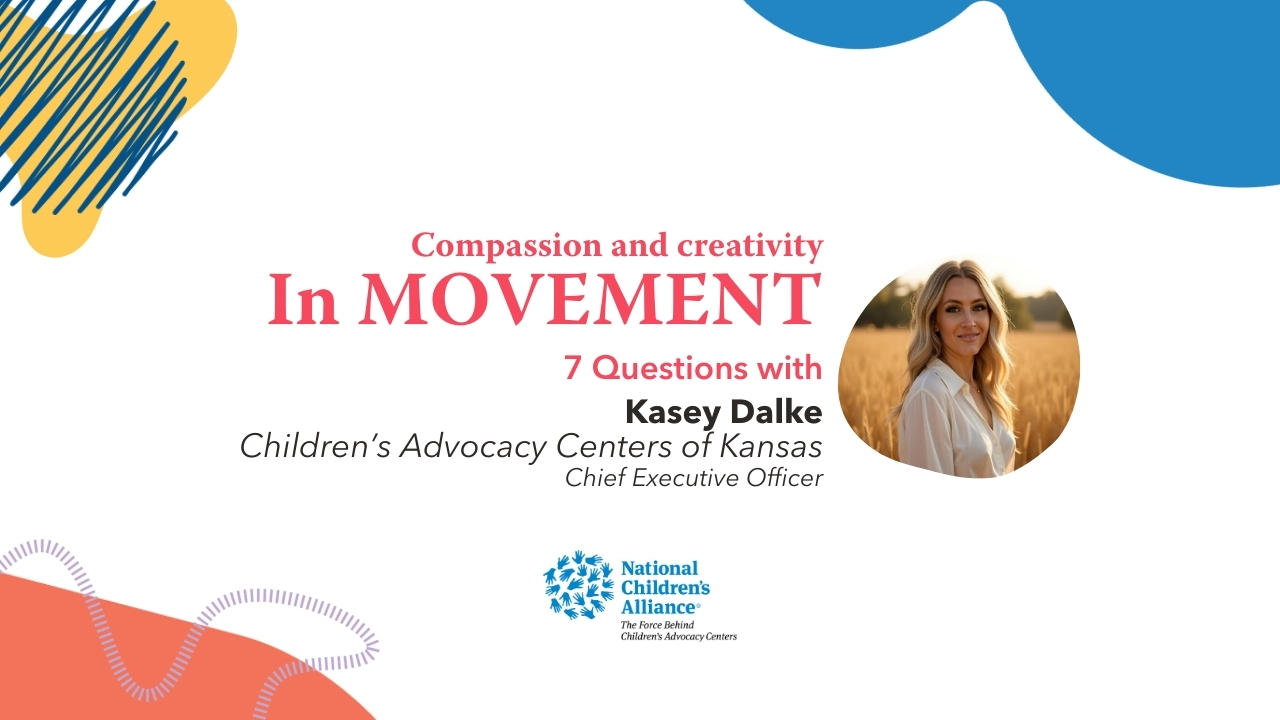
In Movement: 7 Questions with Kasey Dalke | Children’s Advocacy Centers of Kansas CEO
December 19, 2025
Welcome to In Movement! In this segment of our blog, we interview thought leaders from within our own organizations – from CACs and MDTs and partner agencies – to gain insight into how they have furthered the movement, and how the movement has changed them. We look forward to benefiting from the lessons they’ve learned, the challenges they’ve faced, and the future they envision for themselves, our centers and teams, and the children and families we serve.
Kasey Dalke is the Chief Executive Officer of the Children’s Advocacy Centers of Kansas – the Chapter organization for the 19 centers serving the children and families around The Sunflower State. Her passion for building a safe and just future for kids is apparent from the moment you meet her, and her incredible work speaks for itself. So rather than describe it, you can experience her wisdom, insights, and dedication for yourselves by reading her own words below.

Why did you choose this as a career?
I’ve always had a passion for helping others and being a voice for those who aren’t being heard. Even as a kid, if I saw someone being treated unfairly, I couldn’t sit still—I had to speak up. Over time, I realized that injustice of any kind just doesn’t sit well with me, and children often fall victim to the most horrific injustices imaginable.
I started my career in 2010 working in foster care with no prior experience in the child welfare system. My very first case was child sexual abuse—four children under the age of five. The alleged perpetrators were their father and stepmother. It was heartbreaking, horrifying, and it all took place in a rural community with no CAC. I remember escorting those children, kicking and screaming, to court-ordered supervised visits with their abusers. It felt like more trauma was unfolding with every visit. I kept thinking: This can’t be the best we can do. There has to be something better. There has to be a way to make their voices heard, to protect them, and to support their healing.
That same year, a CAC opened in our community. The moment I stepped inside, it was like every wish I had for how children should be supported in these situations came to life in one place—free of charge. That was my “aha” moment.
In 2013, I became a trained forensic interviewer and entered the CAC world full-time in 2015—and I haven’t looked back. I believe in shining a light on the hard stuff. I believe in standing up for what’s right, educating as many people as I can, building authentic relationships, and always—always—pivoting and problem-solving until we get the outcomes that kids deserve.
What is something interesting that you have learned recently?
I’ve had the opportunity to participate in two transformative learning experiences recently. One was the Kansas Leadership Center’s leadership pathway, which is a comprehensive program grounded in four core competencies: Diagnose the situation, manage self, intervene skillfully, and energize others. One of the most powerful takeaways is their belief that anyone can lead, from anywhere, which completely aligns with how we approach empowerment across our CAC network. We’re currently working to expand access to this training to all CAC staff statewide—because building leadership at every level is how real change sticks.
The other experience that left a lasting mark was attending the NCA Chapter Summit in October. The content was incredibly motivating, and I returned with a fresh fire to redesign our Board of Directors. My biggest realization? Just because we’re a nonprofit doesn’t mean we have to operate from a scarcity mindset. Our work is essential. It saves lives, protects children, and strengthens communities—and it deserves to be resourced accordingly. One of our guiding mantras now is: “The days of taking what we can get are over. We’re done begging for scraps.” At CACKS, we’re building a Board that helps us close critical funding gaps and drive lasting impact—not just for our organization, but for our member centers and, ultimately, the children and families we serve.
What is a challenge that you and your colleagues feel proud of solving?
One of the challenges we’re most proud of tackling is securing new-to-CAC funding sources—resources our field has never accessed before. Over the past year, CACKS launched a statewide initiative to train and expand access to Problematic Sexual Behavior – Cognitive Behavioral Therapy (PSB-CBT). In Kansas, CACs are the only programs offering this critical, evidence-based service.
We identified key issues across state systems—like the long waitlists for PRTFs (Psychiatric Residential Treatment Facilities), the growing number of kids in foster care, and the overall strain on mental health services. Then, we didn’t just point out the problem—we brought a solution.
We worked closely with state leadership, presented a path forward, and ultimately secured a brand-new $1.6 million funding stream to support PSB-CBT efforts across the state. CACKS will serve as the passthrough agency for these funds. This wasn’t luck—it was strategy, persistence, and unity. Our members agreed to do something we’ve never done before: we hired a full-time lobbyist to help carry this work across the finish line.
This moment represents a major culture shift for our Chapter. For CACs in Kansas to receive what we’ve never received, we must do what we’ve never done. And now, we’re doing it—together. The past three years we’ve worked hard to build a culture of collaboration and courage. This year, that work is finally blooming. The energy, the alignment—it’s incredibly exciting. It’s a new era for CACKS and our members.
What about your work inspires you and keeps you going?
I actually keep a little collection of documentation—notes, emails, photos, reminders of the impact we’ve made—right within eyesight of my desk. On the days I feel like screaming, I scream (because let’s be real), then I look at that wall and remind myself what we’ve accomplished. I take care of myself the best I can, and I lean on my mentors when I need to recalibrate. But nothing centers me more than the moments that remind me why I do this work.
Recently, I was called to testify in a jury trial—one of the cases from back when I was doing direct service. I hadn’t seen the victim in years. As soon as she saw me, she came sprinting across the courthouse lawn and threw her arms around me. Through tears, she said, “Thank you for hearing me.”
I don’t do direct service anymore, but that moment reminded me of every single “me” out there across Kansas and across the country—hearing kids, showing up for them, doing this hard and sacred work. That’s what keeps me going.
Because on the hardest days, I remember: This work is so much bigger than my stressor or frustration of the moment. My bad day will never compare to the worst day of the children and families who depend on us to keep showing up.
What is the biggest need for kids you think we can meet in the next 5 years?
I believe there are still far too many kids slipping through the cracks. Even with an incredible model like ours, there can be unintended barriers for families—whether it’s a lack of awareness about CAC services, or a lack of trust in the systems that refer children to us in the first place.
At CACKS, we’re constantly asking: How do we innovate to close those gaps?
CACs are uniquely positioned as a trusted, neutral third party. Families often feel safer letting their guard down with us, which allows them to access the support they truly need. That’s a powerful foundation—but we need to build on it.
I worry when I see other systems focusing solely on reducing hotline calls or investigative loads. I can’t help but wonder: At what cost? What happens to the kids who don’t “screen in”? Who’s catching them? Can CACs help fill that space?
I’d love to see stronger partnerships with school districts and referral pathways that step outside of what we’ve always known—pathways that meet families where they are, not just where we expect them to be. I want us to explore what it could look like to work more closely with the judicial system, especially in rural areas where abuse cases often don’t make it to court and resources are stretched thin.
And at the heart of it all is our workforce. We have to take better care of our first responders, our MDT professionals, and our CAC staff. Reducing turnover, supporting mental wellness, and addressing secondary traumatic stress must become part of how we sustain and strengthen this movement.
If we get these things right—trust, access, justice, and workforce support—I truly believe we can meet the needs of more kids than ever before in the next five years.
What do you think the ideal future looks like for kids?
When I look to the future, I see systems working together—not just on paper, but in practice. That starts with each system taking honest inventory of its own role, owning its part of the “mess,” and doing the work to clean it up. No more passing the buck. No more finger pointing. Just accountability and alignment around one central goal: protecting and healing children.
In that future, the general public doesn’t shy away from the topic of child abuse—they understand it, believe it, and know how to respond when they see it. There’s no more hesitation, no more disbelief, no more minimizing.
Instead of blaming each other, systems and partners “circle the wagons” around the child and family. I see more families feeling like they have somewhere to turn—places of safety, support, and empowerment. I see children who feel safe enough to speak out, and strong enough to know they deserve to be heard.
And on a broader scale, I see generational cycles breaking. I see communities that are healthier, stronger, and more connected—because we’ve invested in prevention, education, justice, and healing as a collective priority.
It’s not just about helping kids survive trauma—it’s about building a world where they don’t have to endure it in the first place.
Finally, what is next for you?
Honestly, I’m not entirely sure—and that’s part of the excitement. What I do know is that I’ve discovered a deep love for policy and legislative work. There’s something about stepping into those spaces—whether it’s the Statehouse or a courtroom—that feels like a full-circle moment. It’s the grown-up version of speaking out on the playground when someone was being bullied. That fire to speak out against injustice has never left me—it just evolved.
This role has given me the chance to use my voice in rooms where real decisions are made, and to do so on behalf of kids who don’t always have the chance to be heard. That’s an honor I don’t take lightly. I feel in alignment every day I do this work—even on the hard days.
I’m not chasing a title or the next big role. I’m focused on impact. What’s next is continuing to witness and fuel the innovation of our CACs, coaching and mentoring the next generation of leaders in this field—just as others did for me—and pushing boldly into our next frontier.
Now that we’ve established sustainable funding for mental health treatment across our state, our next big goal is medical access. In Kansas, access to medical evaluations for child abuse is sorely under-resourced—and that has to change. We want to make the gold standard accessible to every child, in every community, no matter their zip code.
What’s next for me? More truth-telling. More system-busting. More building. And always, always: more showing up for kids.
__________________________________________________________