Understanding CFTSI: When Earlier Intervention Can Change the Trajectory
August 25, 2026
By Michelle Miller, Ph.D., LCSW
NCA Institute for Better Mental Health Outcomes
When a child experiences trauma, one of the most important questions we can ask is also one of the simplest:
What can we do to help this child heal, and how soon can we begin?
For kids who have experienced abuse or another potentially traumatic event, timely access to effective mental health treatment can make an important difference. But for many families, getting that care isn’t always easy.
Mental health provider shortages, long waitlists and limited access to evidence-based treatment can leave children waiting weeks before they even begin the assessment process.
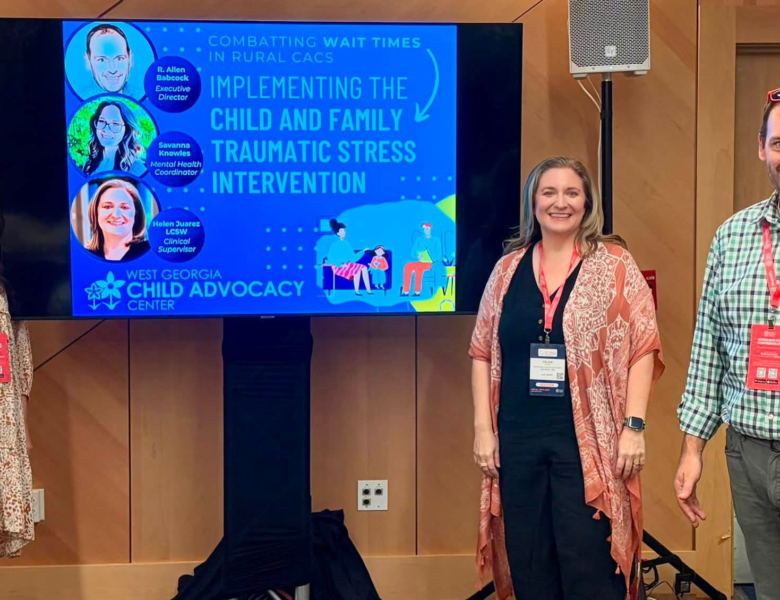
At West Georgia Child Advocacy Center, Mental Health Coordinator Savanna Knowles has seen that challenge firsthand.
“Like many others in Georgia and across the nation, we’re in a shortage area with mental health providers, especially evidence-based mental health providers,” Knowles said. “So, we would send referrals off and kids would be waiting six to eight weeks for an intake session. We also didn’t get much information about that kid’s progress or anything like that.”
For Children’s Advocacy Centers (CACs), finding ways to connect children and families with effective care sooner can be critical. That’s one reason the Child and Family Traumatic Stress Intervention, or CFTSI, can be such an important addition to a clinician’s mental health toolbelt.
A different place in the continuum of care
When we talk about evidence-based trauma treatment for children, Trauma-Focused Cognitive Behavioral Therapy (TF-CBT) is often one of the first models that comes to mind, and for good reason. TF-CBT is a well-established, research-backed treatment that can be highly effective for children experiencing the effects of trauma.
But not every child enters care at the same point in their recovery, and not every child needs the same type or length of intervention.
For Elizabeth Ojeda, MS, LMFT, a Marriage and Family Therapist with the Chadwick Center for Children and Families in San Diego, long-term treatment meant families could be in therapy for months, or sometimes much longer.
“I was doing long term treatment. What that means is that the families were coming in for longer periods of time,” Ojeda said. “We will see them for months, sometimes even for a year, depending on their needs.”
CFTSI offers another option as a brief 5-8 session early intervention specifically developed to reduce traumatic stress symptoms and interrupt the development of PTSD and related disorders in children and adolescents. It’s designed for the early phase of a child’s trauma response, ideally within 30 to 45 days after a recent traumatic event or disclosure of abuse.
The goal isn’t to replace longer-term trauma treatment when a child needs it. Instead, CFTSI can provide an early intervention that helps children and families address traumatic stress symptoms and determine what additional care, if any, may be appropriate.
Helping children, and their caregivers, heal together
One of the defining elements of CFTSI is its focus on both the child and the caregiver.
“CFTSI really focuses on increasing caregivers’ understanding of their child’s trauma symptoms as well as their own,” said Carrie Epstein, LCSW-R, co-developer of CFTSI and Director of the Yale Center for Traumatic Stress and Recovery. “Improving children’s awareness and recognition of their trauma symptoms, increasing communication between children and caregivers about those symptoms, and identifying and practicing concrete coping strategies that help children and caregivers gain greater mastery over trauma symptoms and regain a sense of control.”
That involvement matters.
“We all know in the CAC world that for a child to heal, their caregiver has to be supportive and help them heal,” Knowles said.
For Ojeda, involving caregivers from the beginning has allowed families to better understand what a child is experiencing.
“Since I am the therapist at first hand sees them, we get to begin the assessment right after the disclosure or right after the trauma has happened,” she said. “So, we know that the children and the youth are experiencing their trauma responses. And so, with the caregivers, we get to have the caregivers be part of it so they could support their children or youth that they’re going through this trauma.”
The result, Ojeda said, is something she sees throughout treatment.
“I’ve seen success in the sense that they begin with symptoms and then towards the end of it we see the reduction of those symptoms,” she said.
A brief intervention can expand access to care
For CACs, the potential impact of CFTSI extends beyond the individual child and family.
“Many children who experience meaningful symptom reduction through CFTSI may not require more intensive or longer-term trauma-focused treatment afterwards, which may help CACs expand overall access to care for children and families impacted by trauma,” Epstein said.
That can be particularly meaningful in communities where mental health providers are in short supply.
Kasey Jackson, LCSW-S, Vice President of Programs for Children’s Advocacy Centers of Texas, saw that potential when Texas began expanding access to CFTSI.
“Because it’s a short-term model, it would allow our centers to serve more families overall,” Jackson said. “So, I think that combination, the impact that we knew and the accessibility made it, I think, a really compelling fit for us.”
Texas began with a small pilot involving five urban CACs in 2020. After seeing promising early results, the program expanded to rural and mid-sized CACs.
Today, more than 200 clinicians across 49 CACs in Texas have been trained in CFTSI, helping bring the model to communities across the state.
Measuring the impact of CFTSI
The experiences of children and families are at the heart of this work, but measuring outcomes is also important.
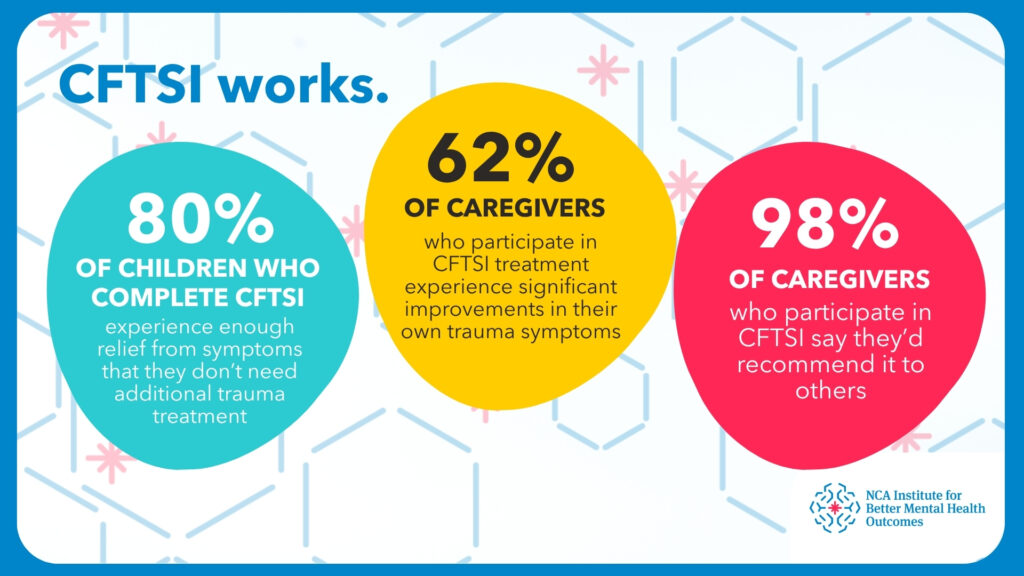
Research on CFTSI demonstrates meaningful improvements for both children and caregivers. Among children who complete CFTSI, 80% experience enough relief from their symptoms that they do not need additional trauma treatment. That doesn’t mean every child will have the same experience or that longer-term treatment won’t be appropriate when needed. Rather, it demonstrates the potential of a brief early intervention to make a meaningful difference for many children.
The impact can extend to caregivers, too. 62% of caregivers who participate in CFTSI experience significant improvements in their own trauma symptoms, while 98% of caregivers who participate say they would recommend CFTSI to others.
Those numbers reinforce an important part of the CFTSI approach: supporting the child also means supporting the people who are helping that child heal.
For providers like Elizabeth Ojeda, the impact is also visible in the way families begin to move forward.
“As a CFTSI therapist, we are also providing through the education, we’re instilling hope for these families.”
That hope is an important part of the work.
The goal of CFTSI isn’t simply to reduce a number on a screening tool. It’s to help children and caregivers understand trauma responses, develop strategies to manage those symptoms, strengthen their communication and regain a sense of control.
The more evidence-based tools available to trained providers, the better equipped CACs can be to respond to the individual needs of children and families.
And ultimately, that’s the goal: not simply providing a treatment, but connecting each child and family with the support that is right for them.
Because when a child experiences trauma, we shouldn’t have to wait to start helping.
Early intervention can help children and families begin the path toward healing sooner, and CFTSI is one tool that can help make that possible.
__________________________________________________________
The NCA Institute for Better Mental Health Outcomes is helping CAC professionals learn more about CFTSI and how the model can be incorporated into their work. It offers CFTSI resources for both providers and caregivers, including explainer videos and fact sheets, with resources also available in Spanish.
For CAC professionals interested in training, the NCA Institute is offering CFTSI training through MHub October 28–30, 2026. Click here to register.
Whether you’re a clinician considering adding CFTSI to your CAC’s services, an advocate looking for resources to share with families, or a caregiver trying to understand the options available to your child, we encourage you to learn more.
And for those of you who are already trained, but are looking for additional information, NCA has resources at your fingertips: CFTSI NCA Resources – NCA Engage: The Child And Family Traumatic Stress Intervention (CFTSI) as well as a video that was created for the 2026 Leadership Conference, CFTSI: Early Intervention, Lasting Impact.

Michelle Miller, Ph.D., LCSW is the Director of the NCA Institute for Better Mental Health Outcomes. She has 27 years in CAC work, founding a CAC and Montana’s NCA chapter. She’s led NCA’s mental health efforts for 10 years and has 25 years as a trauma therapist. She enjoys Montana’s mountains with family.