Closing the Gap: What CFTSI Is Teaching Us About Early Intervention and Community Response
September 22, 2026
By R. Allen Babcock, Executive Director, and Savanna Knowles, Mental Health Coordinator,
West Georgia Child Advocacy Center
Like many Children’s Advocacy Centers (CACs), we have spent a lot of time thinking about the gap between the forensic interview and meaningful mental health intervention.
We can conduct a timely forensic interview. Advocacy can begin immediately. Referrals can be made.
But making a referral and getting a child into treatment are not the same thing.
That distinction is especially significant in rural communities, where provider shortages, transportation, distance, caregiver work schedules, and waitlists can leave families without treatment during a critical period following disclosure.
At West Georgia Child Advocacy Center (WGACAC), that challenge led us to the Child and Family Traumatic Stress Intervention (CFTSI).
CFTSI is a brief, evidence-based intervention designed for children and caregivers in the early period following a traumatic event or disclosure. For us, it offered something we were missing: an opportunity to do more than refer a family and wait.
What began as a strategy for addressing mental health wait times has now changed how we think about the entire continuum from disclosure to treatment, and increasingly, about the role our CAC can play in the broader community response to childhood trauma.
Making CFTSI Part of the CAC Workflow
The clinical model made sense to us almost immediately. Implementation took more work.
The real question was: How do we get an appropriate child from the forensic interview into CFTSI quickly enough for early intervention to actually be early?
That required more than training clinicians.
We had to examine screening, referral timing, caregiver engagement, scheduling, documentation, clinical supervision, outcome measurement, telehealth, and communication among advocates, forensic interviewers, clinicians, interns, and supervisors.
We learned quickly that CFTSI could not simply sit alongside our other services. It had to become part of the workflow.
A warm handoff matters. So does having an advocate who can explain CFTSI confidently to a caregiver. So does beginning the referral process while the family is still engaged with the CAC rather than expecting them to navigate another system later.
Those operational details may not be the most exciting part of implementing an evidence-based treatment, but we have come to believe they are where implementation succeeds or fails.
Building Capacity, Not Just a Program
CFTSI has also changed how we think about workforce development.
Through training facilitated by the NCA Institute for Better Mental Health Outcomes, our clinical interns have had the opportunity to learn directly from Carrie Epstein, LCSW-R, Co-Director of the Yale Center for Traumatic Stress and Recovery and co-developer of CFTSI.
Carrie’s impact on our interns has gone well beyond teaching the steps of the model. They have learned the clinical reasoning behind CFTSI: why the early post-trauma period matters, how differences between child and caregiver reports can become clinically useful, how strengthening caregiver-child communication supports recovery, and how CFTSI can help determine whether a child needs longer-term treatment.
For a rural CAC, that kind of workforce development matters enormously.
We cannot solve the shortage of trauma-trained clinicians simply by competing for the same limited pool of providers. We also have to help develop the next generation of clinicians who understand evidence-based trauma treatment and know how to practice within the CAC environment.
Our interns are becoming an important part of that strategy.
Access Has to Be More Than Availability
WGACAC serves Carroll, Haralson, and Heard Counties in West Georgia, including rural communities where access has influenced nearly every decision we have made about CFTSI.
Most CAC professionals know this reality well: a service can be available without being truly accessible.
A caregiver may not be able to repeatedly miss work. A family may live 45 minutes from the CAC. Transportation may be unreliable. A child may already be missing school for interviews, medical appointments, or court.
Those realities have pushed us toward telehealth, flexible scheduling, stronger warm handoffs, and integration with our expanding rural service presence in Tallapoosa and Franklin.
The lesson has been simple: evidence-based practice still has to work in the real lives of the families we serve.
Then We Started Seeing the Data
As implementation grew, we became increasingly intentional about measuring outcomes.
Using the Child PTSD Symptom Scale for DSM-5 (CPSS-5), our emerging matched pre- and post-intervention data have been encouraging.
Among participants with completed pre- and post-CFTSI measures:
– Average caregiver-reported CPSS-5 scores decreased from 19 at intake to 5.7 following CFTSI.
– Average child-reported CPSS-5 scores decreased from 33 at intake to 10 following CFTSI.
We are appropriately cautious with early program data. Our sample continues to grow, and we want to strengthen completion, follow-up, and analysis as our CFTSI population expands.
But we also do not want to overlook what we are seeing.
These are meaningful reductions in reported trauma symptoms.
Our clinical team is also seeing what the numbers cannot fully capture: caregivers recognizing trauma reactions differently, children communicating more clearly about what they are experiencing, and families developing concrete strategies they can use together.
For us, those outcomes provide good reason to keep building.
Sharing What We Were Learning
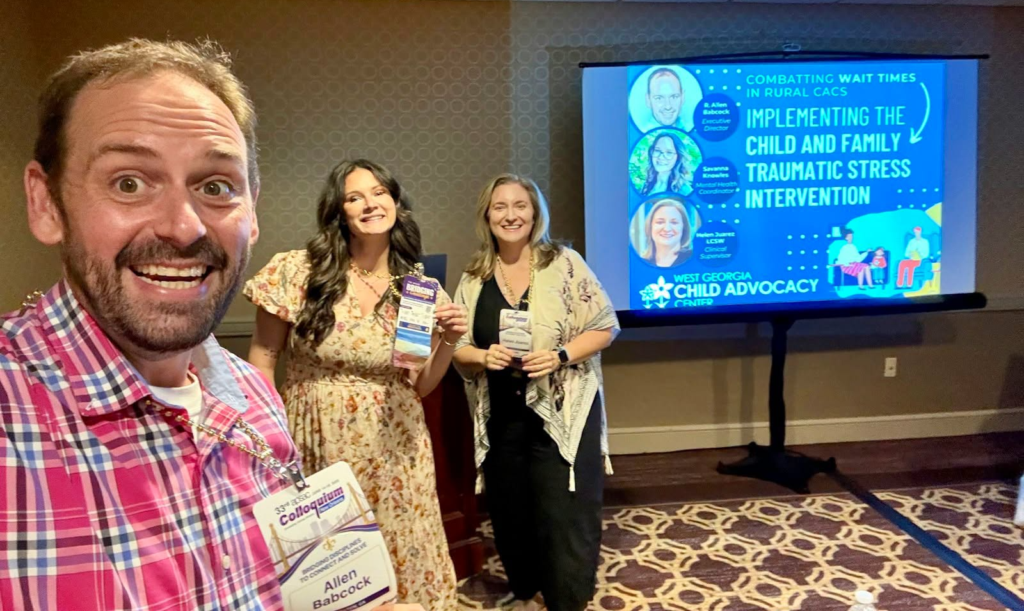
This summer gave us two opportunities to share the work with colleagues nationally—and, just as importantly, to hear how other professionals are approaching the same challenges.
At the 33rd APSAC Colloquium in New Orleans, in June 2026, we shared what we were learning about implementation: moving from training to routine practice, building clinical capacity, engaging caregivers, using telehealth, and integrating early intervention into an already busy CAC environment.
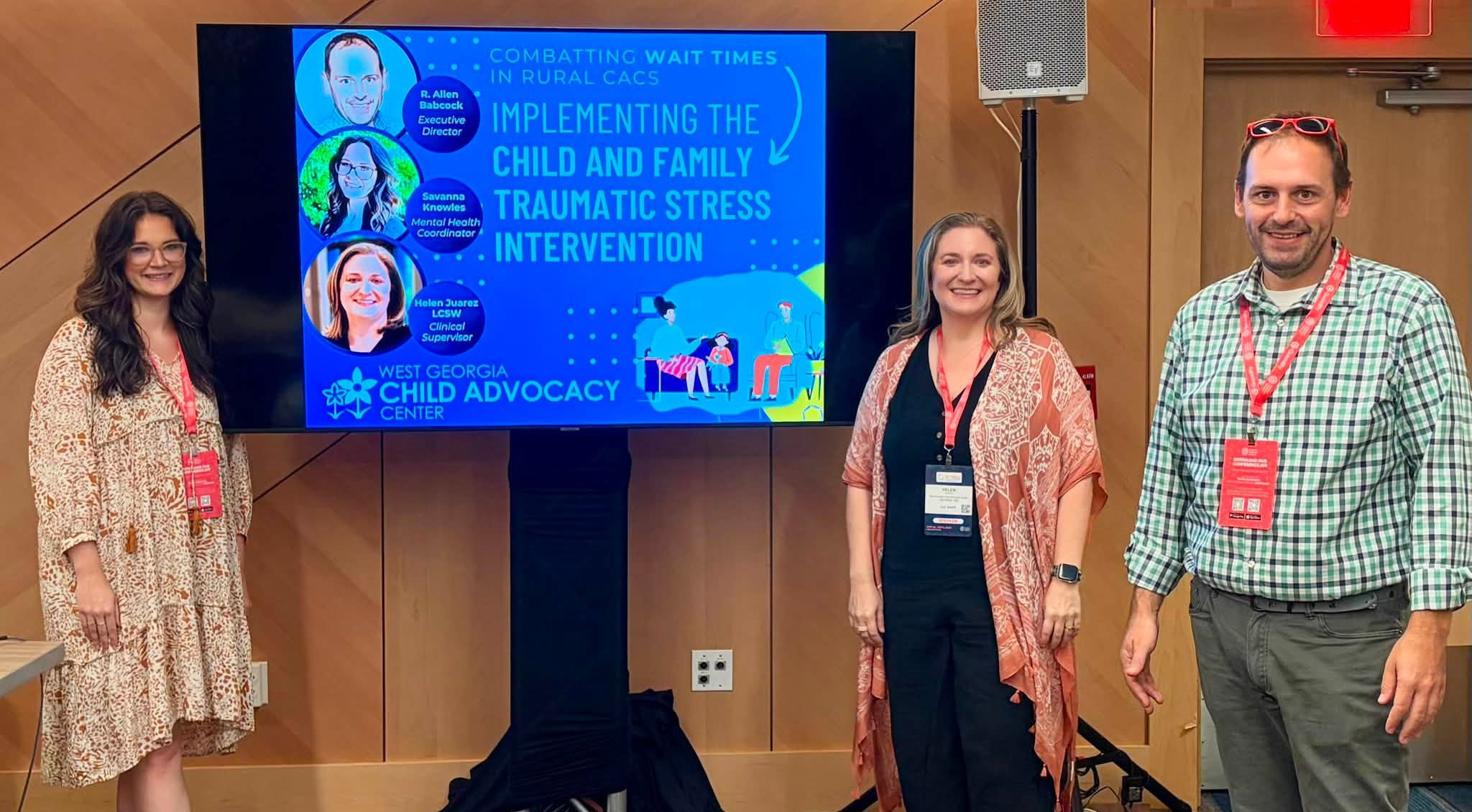
Two weeks later, at the NCA Leadership Conference in Washington, D.C., we focused specifically on using CFTSI to address mental health wait times in rural CACs.
Those conversations reinforced that West Georgia is not unique.
CACs across the country are confronting increasing demand, workforce shortages, limited specialized providers, and families who need help sooner than the behavioral health system can always provide it.
CFTSI has changed the way we think about that gap.
Instead of automatically viewing the period between the forensic interview and longer-term treatment as a waiting period, we can now see it, when clinically appropriate, as an intervention period.
CFTSI does not replace TF-CBT or other longer-term evidence-based treatments when they are needed. It gives us another point on the continuum: an intervention that can begin quickly while also helping determine what a child may need next.
Something Bigger Is Beginning to Happen
Perhaps the most unexpected development has been that CFTSI at WGACAC is no longer exclusively connected to children receiving forensic interviews.
It is beginning to function as part of a broader community trauma response.
Recently, we provided CFTSI to a child who discovered another youth following a death by suicide. We also began working with three children whose caregivers were involved in a murder-suicide.
None of those children needed forensic interviews from our CAC.
They did need help.
And, all of them were able to begin CFTSI before the funerals had even occurred.
That experience has expanded our thinking about what the capacity we have built can mean for our community.
The same infrastructure developed to respond quickly following abuse disclosures: trained clinicians, screening, caregiver engagement, rapid scheduling, telehealth, clinical supervision, and evidence-based early intervention can sometimes provide a pathway for children experiencing other forms of acute trauma.
We are not suggesting that CACs become the answer to every community mental health need.
But when a child experiences profound trauma, and a CAC has the expertise and capacity to intervene, we believe there is value in asking whether that child really needs to wait simply because there was no forensic interview.
What Comes Next
Our next steps are focused on access and reach.
We are excited about opportunities to expand CFTSI to potentially serve younger children, giving us another way to intervene early with families who may otherwise have very limited evidence-based options.
We are also expanding telehealth delivery so that geography, transportation, caregiver work schedules, and distance from a CAC do not become reasons a child misses the window for early intervention.
For us, telehealth is not simply a convenience. It is an access strategy, particularly in rural communities where the barrier is often not willingness to participate, but the practical difficulty of getting to treatment consistently.
CFTSI began for us as a way to shorten the distance between forensic interview and mental health treatment.
Increasingly, we see the possibility of something bigger: shortening the distance between a child experiencing trauma and a community being able to respond.
Our early data give us reason to be encouraged. Expanding to younger children and strengthening telehealth access give us clear next steps.
And that is what makes what comes next so exciting.
Sources:
National Children’s Alliance, “Ask the Institute: What is CFTSI?” NCA describes CFTSI as a brief, 5–8 session evidence-based treatment designed for the early phase following a traumatic event or recent disclosure and discusses both its outcomes and telehealth delivery.
National Child Traumatic Stress Network, Child and Family Traumatic Stress Intervention (CFTSI): At-a-Glance. Overview of the CFTSI model, treatment goals, evidence base, and use following traumatic events or forensic interview disclosures.
National Children’s Alliance, NCA Institute for Better Mental Health Outcomes. The Institute focuses on strengthening the child-trauma workforce through evidence-based mental health training, including CFTSI.
Child Study Center at the Yale School of Medicine, Carrie Epstein, LCSW-R. Epstein is Co-Director of the Yale Center for Traumatic Stress and Recovery and co-developer of CFTSI.
Association of Professionals Solving the Abuse of Children, 33rd APSAC Colloquium, New Orleans, June 14–18, 2026.
National Children’s Alliance, 30th Annual NCA Leadership Conference, Washington, D.C. and virtual, June 29–July 1, 2026.
WGACAC outcome data are drawn from the Center’s internal CFTSI pre- and post-intervention CPSS-5 measurement data.
__________________________________________________________
For CAC professionals interested in training, the NCA Institute is offering CFTSI training through MHub October 28–30, 2026. Click here to register.
Whether you’re a clinician considering adding CFTSI to your CAC’s services, an advocate looking for resources to share with families, or a caregiver trying to understand the options available to your child, we encourage you to learn more.
And for those of you who are already trained, but are looking for additional information, NCA has resources at your fingertips: CFTSI NCA Resources – NCA Engage: The Child And Family Traumatic Stress Intervention (CFTSI) as well as a video that was created for the 2026 Leadership Conference, CFTSI: Early Intervention, Lasting Impact.

R. Allen Babcock serves as Executive Director of West Georgia Child Advocacy Center, where he leads the organization’s work to strengthen coordinated, trauma-informed responses to child abuse across Carroll, Haralson, and Heard Counties. In addition to organizational leadership, Allen is a Certified ChildFirst® Forensic Interviewer and works closely with multidisciplinary partners, community leaders, and service providers to improve systems serving children and families. He is especially passionate about collaboration, innovation, and expanding access to high-quality services in rural communities.
Allen brings nearly two decades of experience in leadership and education in the United States and internationally. He holds a Master of Arts in Organizational Leadership from Teachers College, Columbia University, and regularly presents on child advocacy, multidisciplinary collaboration, rural service delivery, and innovative approaches to supporting children and families. Outside of his work at WGACAC, Allen enjoys opportunities to learn, travel, connect with others, and explore new ideas.

Savanna Knowles serves as the Mental Health Coordinator, Forensic Interviewer, and Family Advocate at West Georgia Child Advocacy Center. In her role as a Family Advocate, she provides ongoing support, resources, referrals, and intervention services to children and their non-offending caregivers throughout the investigative and healing process. Savanna is especially passionate about ensuring that every child is heard, supported, and connected with the services they need. In August 2023, she completed certification in the ChildFirst® Forensic Interview Protocol.
Savanna first joined WGACAC in January 2023 as a senior university intern and transitioned into a Family Advocate position later that spring. She earned her B.S. in Psychology with a minor in Sociology from the University of West Georgia and is currently pursuing her Master of Social Work degree. Outside of work, Savanna enjoys spending time with family and friends, traveling and sightseeing, and discovering new restaurants.